

AI, automated marketing and the question of how much visibility a business really needs.
Artificial people tell absurd stories, virtual characters embark on grotesque adventures, and perfectly staged videos show things that have never existed. Content like this is now spreading across YouTube, Instagram and TikTok on a massive scale. Often just a few seconds long, technically impressive and completely devoid of meaningful substance.
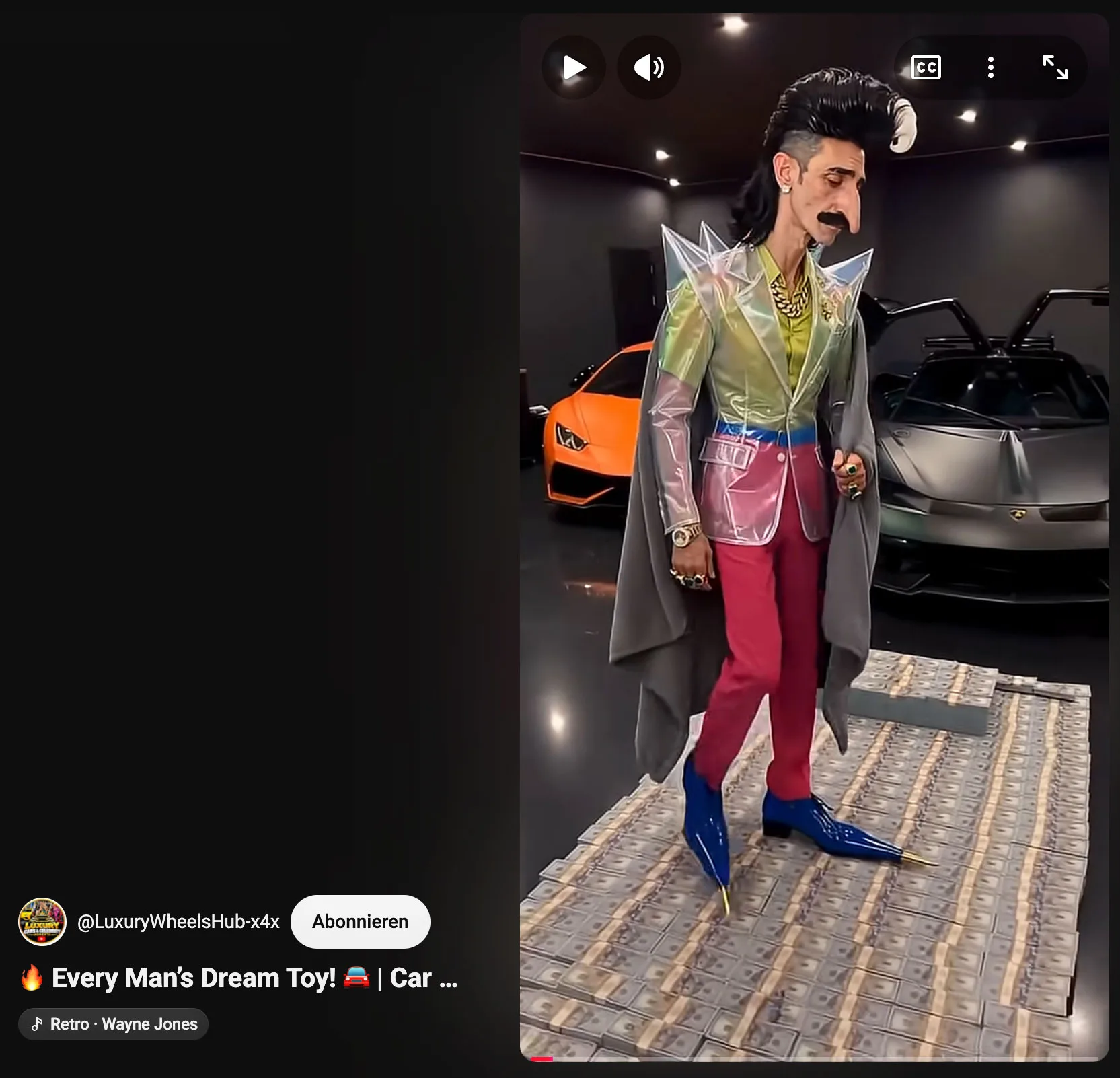
The phenomenon has a name: AI slop. Content created less to communicate something meaningful than to attract attention.
The principle can be seen in countless AI-generated short videos. Grotesquely distorted characters, luxury sports cars and wildly exaggerated scenes are designed to capture attention within seconds. Whether these scenes actually tell a story or offer any useful information seems secondary. What matters, above all, is stopping viewers from scrolling past.
What is new is not the lack of substance. The internet has always had plenty of that. What has changed is the speed at which such content can now be produced in virtually unlimited quantities.
And this development is increasingly finding its way into the marketing of small businesses.
What initially sounds like a tremendous opportunity for the self-employed raises a fundamental question: Does artificial intelligence really make communication better, or are we simply going to produce more of it?
When Everyone Can Produce Everything
Just a few years ago, creating professional media content required time, experience and a certain budget. Videos had to be filmed, images designed and texts written.
Today, AI tools are taking over an increasing share of this work. Images, videos, voiceovers and written content can be generated, adapted and prepared for different platforms.
For small businesses, this opens up opportunities that were previously often reserved for larger companies.
A tradesman can explain his services visually, a retailer can present products, and a consultant can communicate specialist knowledge in an accessible way. Even without a dedicated marketing team, professional content can now be created with relatively little effort.
At first, this is a welcome development.
However, the same tools are available to everyone else. While the volume of published content continues to grow, the audience’s available time remains limited.
In the past, media production was the limiting factor. Today, human attention is increasingly becoming the scarce resource.
This changes a crucial question: It is no longer simply about what a business can publish, but why anyone should be interested in it in the first place.
New Opportunities, New Dependencies
The advantages of automated media production are obvious. AI can reduce costs, speed up workflows and help businesses experiment with new ideas.
A well-prepared specialist article, for example, can form the basis of several publications: a blog post, short pieces for social media or an explanatory video. Existing information does not have to be developed from scratch every time.
For self-employed people who manage their marketing alongside their day-to-day business, this can provide considerable relief.
But low production costs also have a downside.
When content can be generated almost at will, the temptation to publish as much as possible is never far away. What began as a useful way to reduce the workload can turn into an additional responsibility that constantly demands new material.
Then there is the dependence on platforms and their algorithms. What attracts attention today may have disappeared by tomorrow. Even high viewing figures guarantee neither lasting visibility nor commercial success.
The crucial question, therefore, is not how cheaply content can be produced, but what value it actually delivers.
Plenty of Reach. But Reaching Whom?
Imagine a small carpentry business.
It publishes a spectacular AI-generated video featuring futuristic workshops, enormous machines and unusual furniture. One hundred thousand people watch it. Thousands react.
A success?
Perhaps. But do viewers now know what furniture the business actually makes? Have they learnt anything about the quality of its craftsmanship? Has the video generated even a single genuine enquiry?
Now consider another video.
The same carpenter demonstrates why he uses a traditional wood joint for a particular piece of furniture. He explains its advantages, shows part of the process and shares something of his experience along the way.
This video reaches just eight hundred people. Some live in his region, and three subsequently express an interest in his work.
Which video was more successful?
Naturally, the answer depends on the business’s objectives. A company aiming to establish an international brand will assess reach differently from a local craftsman.
For many smaller businesses, however, what matters is not reaching the largest possible audience, but attracting the attention of the right people.
Reach is a metric. Trust is a business asset.
And the two are not necessarily connected.
The Credibility Trap
As artificially generated content becomes more widespread, consumer scepticism is growing too.
A Gartner study from September 2026 found that 65 per cent of surveyed US consumers believed businesses were producing too much AI-generated marketing content. Meanwhile, 57 per cent said such content had reduced their trust in brand messaging.

Although these findings cannot be directly applied to Germany, they point to an interesting problem: What businesses regard as modern and efficient communication may not necessarily be perceived that way by their audiences.
The decisive factor is not whether an image, video or character was created using AI.
What matters is the message it conveys.
An artificially generated explainer video can be useful and convincing. A fictional person pretending to be a satisfied customer, on the other hand, crosses a line.
The same applies to virtual brand characters. They can entertain, explain complex subjects and give a business a distinctive identity. If they fit the brand and their artificial nature remains recognisable, there is generally little reason to object.
It becomes problematic when an artificial presentation creates the illusion of a reality that no longer has anything to do with the actual business.
Smaller businesses, in particular, often possess an advantage that large, automated content factories struggle to replicate: personal experience, tangible services and genuine relationships with their customers.
Why would they choose to abandon precisely those strengths?
The Hidden Costs of the Content Flood
Automated content is often considered particularly inexpensive. But low production costs do not necessarily translate into economic efficiency.
AI-generated content still requires an idea, supervision and, where necessary, further editing. Information must be verified, legal considerations taken into account and results evaluated.
An artificially generated product image must not promise features the product does not possess. An automatically written specialist article should not spread false claims. And anyone using synthetic people needs to consider transparency and potential labelling requirements.
There is also a straightforward economic consideration: Every hour a self-employed person spends maintaining social media channels is an hour that may be missing elsewhere.
If the time saved in production merely results in publishing more frequently, nothing has really been gained.
More content offers no commercial advantage as long as its actual value remains unclear.
Good Ideas Are Not Generated Automatically
Perhaps the greatest opportunity artificial intelligence offers marketing lies somewhere else entirely.
Not in producing as much content as possible, but in bringing good ideas to life with less effort.
A skilled trade business has experience, interesting projects and practical solutions to share. A retailer knows its products and the questions its customers ask. A service provider has specialist knowledge that could help other people.
All of this already provides a wealth of relevant subjects.
AI can help structure this information, present it clearly or translate it into visual form. It can simplify workflows and open up new creative possibilities.
Yet the foundation of good communication remains unchanged: a well-considered idea, a clear message and an understanding of the people it is intended to reach.
Even the most powerful technology cannot change that.
The easier content becomes to produce, the more valuable the ability to decide what is worth producing in the first place.
Produce Less. Have More to Say.
Artificial intelligence will continue to transform business communication. Small businesses, in particular, stand to benefit as professional media production becomes easier and more affordable.
But visibility alone is not a business objective. It needs to serve a purpose.
Those who publish simply because technology makes it possible are confusing communication with production. Those who use it to make their experience, services and values visible, on the other hand, can turn AI into a powerful tool.
Perhaps the most important skill in marketing in the future will therefore not be the ability to produce ever more content.
But the ability to recognise which content genuinely has something to contribute.
Because just because we can now generate almost anything does not mean we need to create everything.